
CPlane
CPlane is a managed headless CMS: a control plane for modeling, governing, and delivering structured content once, so websites, mobile apps, portals, and other digital channels can each pull from the same source through standardized APIs, without a code release every time content changes.
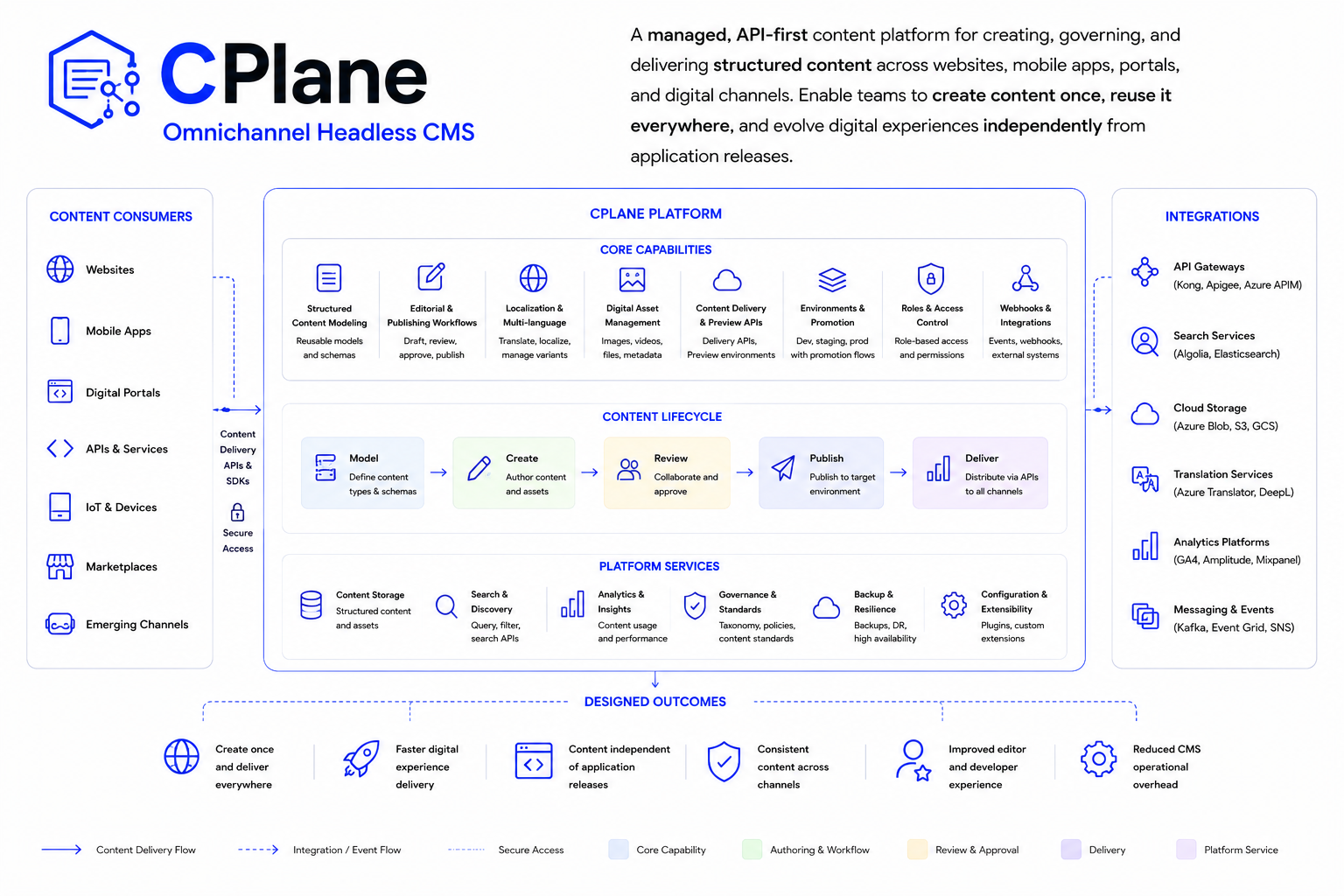
A headless CMS separates content from presentation: content lives in one governed system and is delivered through APIs, while each channel's front end handles its own rendering. CPlane applies this pattern as a packaged, managed offering, implemented on a best-fit headless CMS engine such as Contentful, Sanity, or Strapi, so the underlying technology is chosen to match the customer's requirements rather than fixed in advance. Applications consume content through standardized APIs and SDKs while presentation remains independently owned by each digital channel.
The operating challenge
Content becomes fragmented when websites, mobile applications, portals, and digital solutions maintain separate CMS implementations, content models, publishing processes, and integrations.
What the product provides
CPlane is a managed platform for structured content: one place to define content models, run editorial workflows, manage digital assets and localization, and preview content before it ships.
How it's implemented
CPlane is a packaged offering, not a single fixed product. Infer Origins implements it on the headless CMS engine that best fits the customer's requirements, such as Contentful, Sanity, or Strapi, and wraps it with the governance, integration, and delivery patterns that make it consistent across channels.
How teams consume the platform
Content teams own governance and publishing; application teams pull that content into websites, mobile apps, portals, and other channels through standardized APIs and SDKs, so a content update doesn't require a code release, and a UI change doesn't require touching the CMS.
How adoption starts
Start with one content domain or digital product, establish reusable content models and publishing standards, integrate representative channels, and progressively expand shared content across solutions and markets.
Who it is for
Organizations building composable, omnichannel, or headless digital platforms that need a consistent control plane across content, applications, APIs, and delivery channels.
When not to use it
When a conventional CMS, SaaS application, or single-channel implementation can meet the requirement without introducing a separate control-plane architecture.