
Problem
An energy client's existing data environment needed to evolve toward a platform model that could support multiple teams and data domains without creating isolated pipelines, duplicated infrastructure, inconsistent governance, or unclear operational ownership.
Constraints
The platform needed to support governed access to data across organizational boundaries while maintaining security, lineage, operational control, and repeatable infrastructure.
The client's IT organization and business teams were moving in different directions, while no common core infrastructure existed to leverage existing capabilities. Part of the challenge was therefore to establish the shared infrastructure while simultaneously ramping up engineering capability.
Migration had to coexist with existing ingestion and processing patterns, requiring a progressive transition rather than a single replacement event.
Some edge-system data flows depended on tribal knowledge and had never been formally documented. This created knowledge gaps for development teams and solution architects.
Architecture
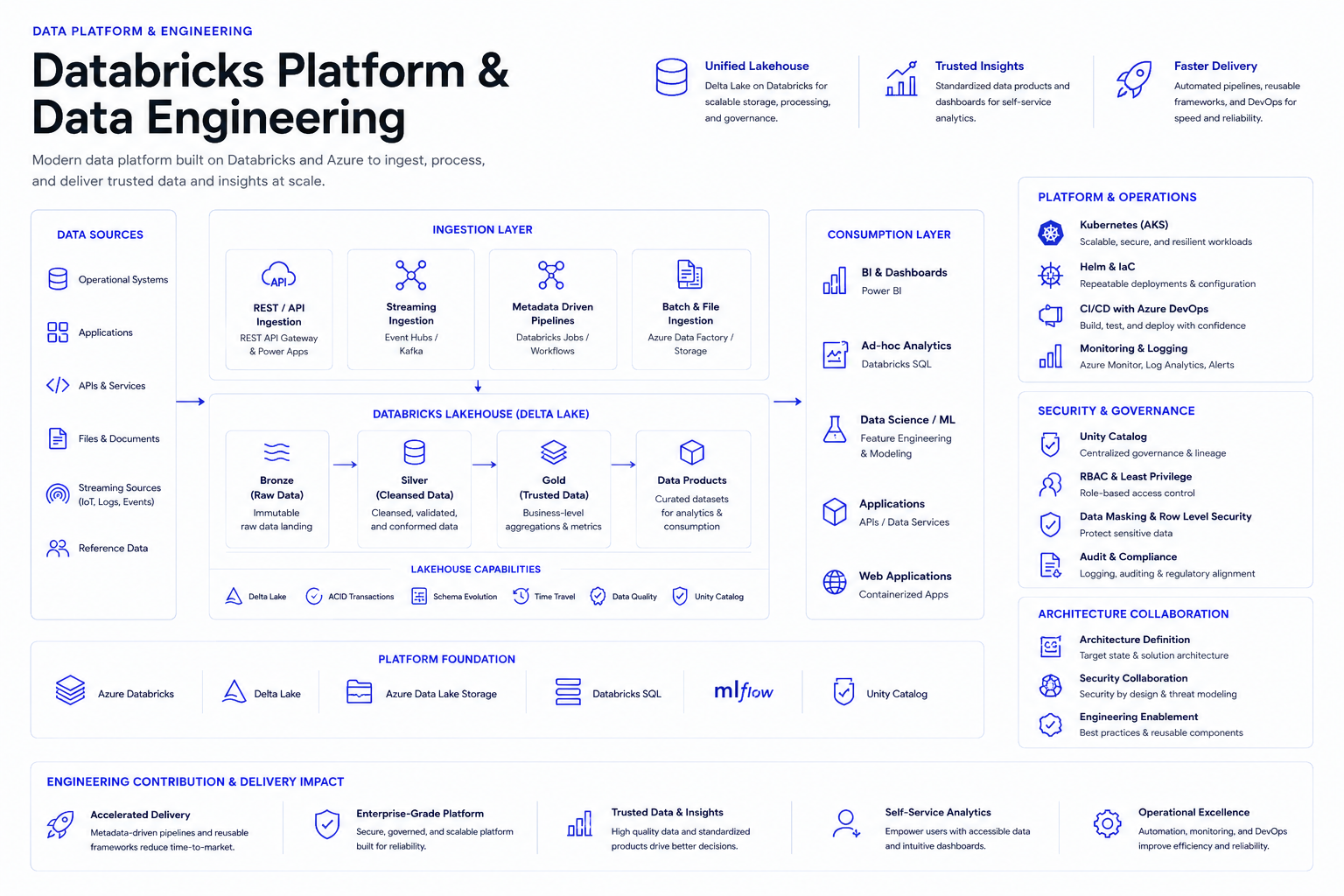
Databricks formed the primary analytics and data-processing platform, supported by cloud-native ingestion, storage, identity, networking, and governance capabilities.
The architecture separated platform foundations from domain-owned data products. Shared infrastructure and governance controls provided consistent boundaries while allowing individual teams to own and evolve their data workloads.
Decisions
Infrastructure-as-code was used to make environments reproducible and reduce configuration drift. Data governance and sharing were designed as platform capabilities rather than handled independently inside each workload.
The platform adopted an incremental migration approach so representative workloads could validate the operating model before broader adoption.
An architectural artifact covering the end-to-end flow from edge systems to the cloud platform was created to establish a shared technical reference and reduce dependency on tribal knowledge.
Implementation
Terraform was used to automate platform infrastructure and environment configuration. Existing ingestion workflows were integrated with Databricks while governance, sharing, and operational controls were introduced alongside the migration.
The implementation established repeatable patterns for workspace configuration, data access, deployment, monitoring, and ownership.
Shared engineering infrastructure, including DevOps tooling, artifact management, and CI/CD capabilities, was established and application teams were progressively onboarded onto these common platform services.
Outcome
The platform established a more consistent foundation for data engineering and analytics, with clearer ownership boundaries, standardized infrastructure, governed sharing, and a repeatable route for migrating additional workloads.
Reusable utility programs, libraries, and CLI tools were developed to simplify common data-processing and integration tasks for application teams.
The libraries were designed around interface and plugin patterns, making it easier to extend platform capabilities and introduce additional integrations without tightly coupling them to individual workloads.
What we learned
Data-platform modernization is as much an operating-model problem as a technology problem. Databricks and infrastructure automation provide the foundation, but sustainable adoption depends on ownership, governance, deployment standards, shared engineering capabilities, and a clear path for teams to consume the platform.
Documenting the end-to-end architecture is especially important when legacy and edge-system integrations depend on tribal knowledge. Establishing shared architectural artifacts alongside reusable platform tooling helps engineering teams move from individual implementations toward repeatable platform patterns.