
Problem
Engineering teams needed a consistent way to deploy and operate Large Language Models on distributed edge GPU infrastructure without every application team building its own inference, deployment, governance, and operational stack.
AI workloads also needed to run close to their data and users, maintaining low inference latency, data locality, and the ability to continue operating in environments with limited or unavailable connectivity.
Constraints
The platform had to operate across distributed GPU-enabled edge clusters while providing a consistent application interface and standardized operational model.
Inference workloads required support for model versioning, streaming inference, quantized models, GPU workload scheduling, controlled model deployment, observability, and offline operation.
Application teams needed self-service access without taking ownership of the underlying Kubernetes, GPU infrastructure, model lifecycle, or platform operations.
Architecture
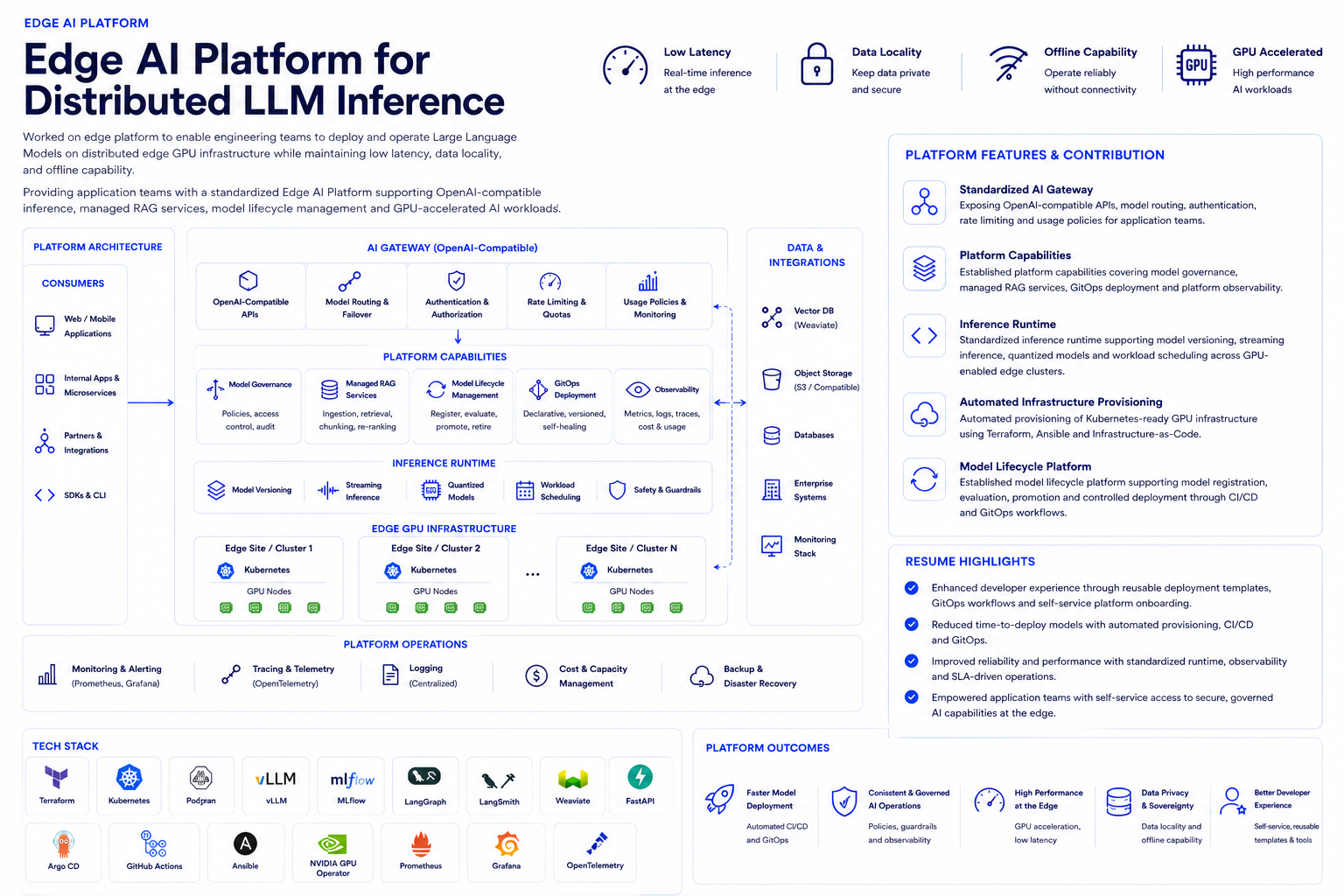
An OpenAI-compatible AI Gateway provided a standardized entry point for application teams, including model routing, authentication, rate limiting, and usage policies.
Shared platform capabilities provided managed RAG services, model governance, model lifecycle management, GitOps deployment, and observability around a standardized inference runtime running across Kubernetes-based GPU edge clusters.
The platform integrated vector storage, enterprise data sources, model services, monitoring, and telemetry while keeping inference execution close to the edge.
Decisions
OpenAI-compatible APIs were adopted as the application-facing contract so teams could consume inference services without coupling applications directly to individual models or inference runtimes.
Model lifecycle management was treated as a platform capability, covering model registration, evaluation, promotion, versioning, and controlled deployment rather than allowing unmanaged model releases.
GitOps and Infrastructure-as-Code were used to standardize both application delivery and GPU infrastructure provisioning across distributed edge environments.
Managed RAG was exposed as a reusable platform service so retrieval, vector search, and orchestration capabilities did not need to be independently implemented by every application team.
Implementation
Terraform and Ansible automated the provisioning and configuration of Kubernetes-ready GPU infrastructure across edge environments.
vLLM provided the standardized inference runtime, supporting GPU-accelerated model serving, streaming inference, model versioning, quantized models, and workload scheduling.
MLflow supported model lifecycle management, while Weaviate, LangGraph, LangSmith, and FastAPI supported managed RAG and application-facing AI services.
Argo CD and GitHub Actions established CI/CD and GitOps workflows for controlled platform and model deployment, with the NVIDIA GPU Operator managing GPU capabilities within Kubernetes.
Prometheus, Grafana, and OpenTelemetry provided metrics, dashboards, tracing, and platform observability across the distributed environment.
Outcome
The platform provided application teams with a standardized, governed path for consuming and deploying AI capabilities at the edge while abstracting much of the underlying GPU and Kubernetes complexity.
Reusable deployment templates, automated infrastructure provisioning, GitOps workflows, and self-service onboarding improved developer experience and reduced the effort required to move models into controlled runtime environments.
Standardized inference and observability patterns established a more consistent operational model for running GPU-accelerated AI workloads with low latency, data locality, and offline capability.
What we learned
Operating LLMs at the edge requires more than deploying an inference runtime. The surrounding platform must standardize APIs, GPU infrastructure, model lifecycle management, retrieval services, deployment workflows, governance, and observability.
Separating application teams from the underlying infrastructure through OpenAI-compatible APIs and reusable platform services creates a clearer developer experience while allowing platform teams to govern how models are deployed and operated across distributed edge environments.